

Your developer audits your product pages and finds that images account for 54% of total page weight, your Largest Contentful Paint is failing on mobile for more than half of sessions, and you have 8,000 SKUs across three regional storefronts with a marketing team uploading raw JPEGs every Tuesday.
The problem is not the images. It is that nothing sits between the upload and the browser.
According to HTTP Archive data from 2025, images account for roughly 38% of total web page weight, making them the single largest contributor to page payload. A one-second delay in load time reduces e-commerce conversions by around 7%. At scale, those numbers are not abstract.
The tools in this guide are purpose-built for teams that have outgrown basic cloud storage and need a real image delivery pipeline: one that handles optimization, format conversion, global CDN delivery, and in some cases multi-storefront governance, from a single layer.
TL;DR
- Product image hosting for e-commerce and SaaS requires more than storage: a complete pipeline includes real-time optimization, automatic WebP and AVIF format conversion, and global CDN delivery from a single master image.
- Gumlet is the strongest default for most scaling teams: multi-CDN delivery, automatic format conversion, native Core Web Vitals analytics, and an average image size reduction of 54% without quality loss.
- For large e-commerce catalogs, pricing model matters more than features. Tools that charge per origin image scale in cost with catalog depth, not traffic, which is the wrong direction.
- For multiple storefronts, you need multi-CDN architecture or multi-origin support in a single account. Gumlet and ImageKit.io both do this with bandwidth-based pricing.
- For user-generated images at scale, the upload ingestion layer and the delivery layer are separate problems. Uploadcare handles ingestion; Gumlet or ImageKit.io handles optimized delivery.
- The right tool depends on three variables: catalog size, team technical depth, and whether you manage one storefront or several.
What Separates Infrastructure-Grade Image Hosting from Basic Storage
A product image hosting tool is useful at scale when it combines three things in one pipeline: origin storage, real-time transformation, and global edge delivery. Basic cloud storage like an S3 bucket or Shopify’s native media hosting solves exactly one problem: the file has a URL.
What it does not do is resize that image for a 375px mobile viewport, convert it to AVIF for a Chrome user and fall back to JPEG for older browsers, or serve it from an edge node in Frankfurt rather than a single origin in Virginia.
For teams with thousands of SKUs and variable traffic from multiple geographies, the consequences show up directly in Core Web Vitals scores and conversion data.
Three capabilities separate infrastructure-grade tools from basic hosting:
- Real-time transformation without re-uploading. You upload one high-resolution master image. The platform derives every size, crop, and format variant on request, which makes catalog management survivable at thousands of SKUs.
- Automatic format negotiation. AVIF and WebP deliver roughly 50% smaller files than JPEG at equivalent quality. Infrastructure-grade platforms handle the browser negotiation per request, with JPEG fallback for legacy clients, without any manual export step.
- Multi-CDN or global edge delivery. A single CDN origin introduces latency for users far from that origin. Platforms with multi-CDN architecture route each request to the nearest available edge node, which matters disproportionately for brands with international storefronts.
The 9 Product Image Hosting Tools Compared
Every tool below is actively used by e-commerce or SaaS teams for product image delivery. Consumer image hosts and general-purpose file storage are excluded.
| Tool | Best For | Pricing Model | WebP / AVIF | Multi-storefront | Core Web Vitals Analytics |
|---|---|---|---|---|---|
| Gumlet | SaaS + e-commerce, multi-CDN delivery | Bandwidth-based | Yes (auto) | Yes | Yes (native) |
| Cloudinary | Enterprise DAM + media management | Credit-based | Yes | Yes | Partial |
| Imgix | Developer-controlled URL transforms | Origin images + bandwidth | Yes | Yes | No |
| ImageKit.io | Large catalogs, budget-conscious teams | Bandwidth-based | Yes (auto) | Yes | Limited |
| Sirv | e-commerce with 360-spin and deep zoom | Storage + bandwidth | Yes | Yes | No |
| Cloudflare Images | Teams already on Cloudflare | Per-image flat fee | Yes | Yes | No |
| Bunny.net Optimizer | High-volume, cost-sensitive delivery | CDN bandwidth | Yes | Yes | No |
| ImageEngine | Mobile-heavy, device-aware optimization | Bandwidth-based | Yes | Yes | No |
| Uploadcare | In-product user upload flows, marketplaces | Per-file operations | Yes | Limited | No |
1. Gumlet: Best Platform to Manage Product Images for Multiple Storefronts

Gumlet is an image and video optimization platform built for SaaS, e-commerce, and media products. It processes 1.5 billion media files daily with an average compression rate of 54% and no visible quality loss.
For teams managing product images across multiple storefronts, Gumlet’s multi-CDN architecture is the most operationally significant differentiator. Rather than routing all traffic through a single CDN provider, Gumlet distributes delivery across multiple networks.
A traffic spike during a product launch or a regional outage at one CDN does not degrade the entire delivery layer. This matters considerably when three regional storefronts serve traffic simultaneously from the same image origin.
The Core Web Vitals analytics are native, not bolt-on. Most image CDNs surface aggregate bandwidth data: total requests, bytes served, cache hit rate. Gumlet connects delivery performance to LCP, CLS, and INP at the individual asset level. Knowing that a specific product hero image is causing LCP failures on a specific category page is actionable. Knowing your CDN served 40 terabytes last month is not.
Automatic WebP and AVIF conversion requires no configuration, and the platform generates srcset attributes automatically rather than requiring developers to define breakpoints. Integrations cover WordPress, Shopify, Google Drive, Dropbox, and Zapier, alongside a REST API for headless setups.
For SaaS teams serving both images and video from the same product, Gumlet handles both pipelines from one account, eliminating delivery inconsistency from vendor fragmentation.
Best for: Multiple storefronts, catalogs above 5,000 SKUs, mixed image and video pipelines, or any operation where Core Web Vitals connect directly to revenue.
2. Cloudinary: Best for Enterprise Teams Combining Images, Video, and DAM

Cloudinary is a media experience platform for images, video, and digital asset management, designed for organizations where creative teams, developers, and marketing operations share one asset library. The transformation API supports over 60 parameters including AI-powered background removal, face detection for smart cropping, and 3D model handling for product visualization.
The trade-off is pricing complexity. Cloudinary uses a credit-based billing system where storage, bandwidth, transformations, and derived asset storage are each tracked separately against a shared pool. G2 reviewers consistently identify billing surprises as the most common frustration, and for high-volume e-commerce catalogs, monthly invoices can vary significantly from estimates.
Best for: Enterprise organizations with multi-team creative workflows, combined image and video needs, and investment in DAM-style asset governance.
3. Imgix: Best for Developer Teams With Granular URL-Based Control

Imgix is a real-time image CDN with over 100 URL transformation parameters covering resizing, cropping, color adjustments, format conversion, and text overlays. For developer-led teams building headless commerce setups, the API is the most flexible in the category.
The structural problem for large e-commerce catalogs is the origin image pricing model. Imgix charges per unique master image, separate from bandwidth. A catalog with 15,000 SKUs and five image angles per SKU represents 75,000 origin images.
Cost scales with catalog depth, not traffic. As ImageKit’s published comparison data notes, accounts can be blocked on continuously high origin image counts, and documentation offers no pay-per-use path beyond enterprise tiers.
As catalogs grow, many teams start evaluating the best imgix alternative because of how pricing scales with origin images.
Best for: Developer-led teams with smaller, stable catalogs who prioritize transformation flexibility over cost predictability at scale.
4. ImageKit.io: Best Image Optimization Tool for Large E-commerce Catalogs on a Budget

ImageKit.io is a real-time image and video optimization platform with a URL-based transformation API, a built-in DAM layer, and bandwidth-based pricing with no origin image restrictions. It runs on a network of 700-plus AWS CloudFront CDN nodes.
For teams currently on imgix that are hitting origin image pricing walls, ImageKit is the most natural migration path. The API is structurally similar, the pricing model is more predictable, and the media library is accessible to non-engineers.
Marketing and catalog teams can browse, organize, and update assets without developer involvement, which matters when product images cycle frequently across seasonal collections and color variant additions.
Best for: e-commerce stores with large or growing SKU counts, agencies managing multiple brand catalogs, and SaaS products with in-app image components.
5. Sirv: Best for E-commerce Teams That Need 360-Degree Product Spins
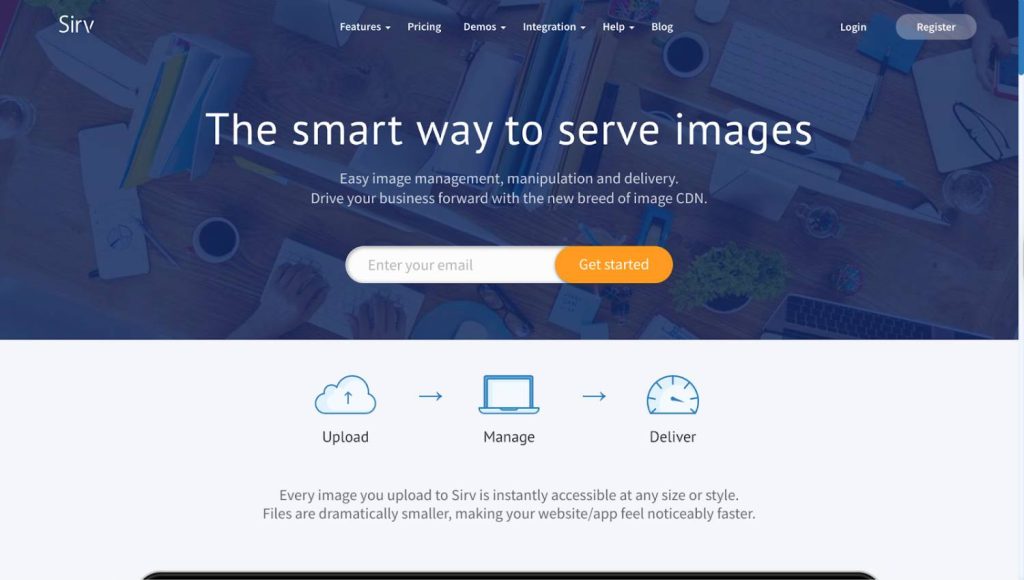
Sirv is an image CDN and product media platform with native support for 360-degree product spins, deep zoom, and responsive imaging. It is the only tool on this list that handles spin viewer delivery as a built-in, CDN-backed feature.
For categories where tactile detail drives purchase decisions, such as footwear, furniture, and jewelry, Sirv serves the spin assets and the viewer from the same CDN layer, eliminating the overhead of a separate viewer plugin. Native integrations include Magento, WooCommerce, BigCommerce, Shopify, and Salesforce Commerce Cloud.
Best for: e-commerce brands in categories where interactive media is a conversion priority.
6. Cloudflare Images: Best for Teams Already on Cloudflare

Cloudflare Images is an image storage and delivery product integrated directly into the Cloudflare network, priced at $5 per 100,000 images stored.
The transformation model uses pre-defined variants rather than dynamic URL parameters, which limits flexibility for teams with evolving display contexts but reduces the attack surface from parameter injection exploits.
Best for: SaaS applications where image display sizes are standardized, or teams with deep Cloudflare investment looking to consolidate vendors.
7. Bunny.net Optimizer: Best for Cost-Sensitive, High-Volume Delivery

Bunny.net’s Image Optimizer adds automatic WebP and AVIF conversion to Bunny CDN’s global network. Pricing comparisons from March 2026 show a medium-traffic site paying $10 to $12 per month on Bunny.net versus $25 to $79 per month on infrastructure-grade platforms that bundle analytics and DAM features.
For lean operations where budget is the primary constraint and the catalog does not require advanced AI transforms or asset governance, that cost differential is a legitimate reason to choose Bunny.net.
Best for: High-volume, cost-sensitive delivery where WebP and AVIF auto-conversion covers the requirement.
8. ImageEngine: Best for Mobile-Heavy Traffic
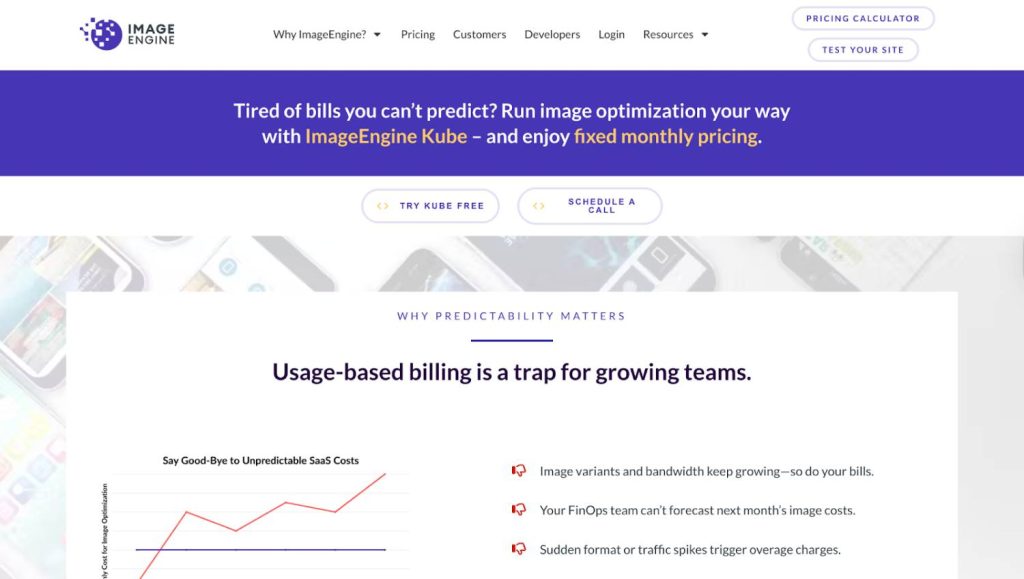
ImageEngine uses device detection at the CDN edge to serve images sized for the requesting device, rather than serving breakpoint-based responsive variants and letting the browser choose.
For D2C e-commerce brands with 60% or more of traffic on mobile, over-serving image weight to small screens inflates bandwidth cost and directly degrades LCP on the sessions most likely to convert.
Best for: D2C e-commerce brands with predominantly mobile traffic.
9. Uploadcare: Best for Image Hosting of User-Generated Images at Scale
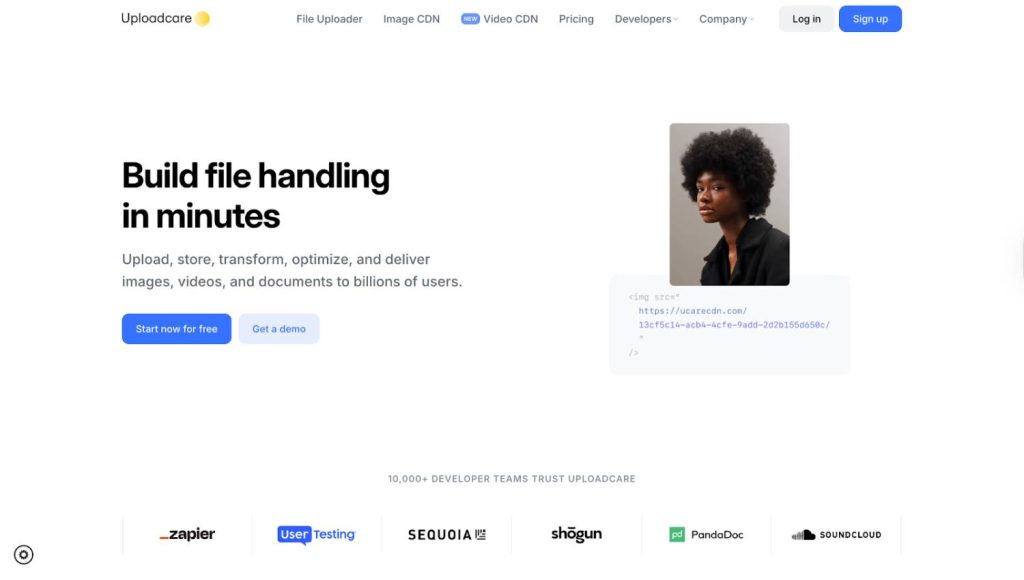
Uploadcare is a file handling platform that combines an image upload widget, cloud storage, real-time processing, and CDN delivery in a single integration, typically embedded directly into product interfaces. It is the only tool on this list built for scenarios where end users upload images as part of the product experience.
Every other tool in this guide assumes the team controls the upload process. Uploadcare handles the opposite: a marketplace where sellers upload product photos, a review tool where customers submit images, a customization flow where buyers upload design assets.
The file widget handles source selection from local storage, Google Drive, Dropbox, Instagram, and Facebook; validates file type and size; runs in-browser compression; and delivers the asset to your chosen cloud storage with a CDN-optimized URL. The entire pipeline is a single SDK integration.
For e-commerce teams building marketplace infrastructure where vendor-uploaded product images need to flow through an optimization and delivery pipeline automatically, Uploadcare handles the ingestion layer that other image CDNs assume you have already solved.
Best for: SaaS platforms with user-facing image upload flows, multi-vendor marketplaces, and e-commerce tools where third-party sellers or customers supply product images directly.
How to Choose Based on Your Actual Setup
Managing product images across multiple storefronts
Once a catalog exceeds approximately 5,000 SKUs with multiple images per SKU, any tool that charges per origin image becomes expensive in a way that compounds with catalog growth rather than revenue. That structurally rules out imgix as the primary platform for high-SKU operations.
For multi-storefront delivery, you need multi-CDN architecture or multi-origin support from a single account. Gumlet and ImageKit.io both cover this with bandwidth-based pricing. Gumlet adds Core Web Vitals analytics at the asset level, which matters when you need to attribute conversion differences across storefronts to specific images rather than to general infrastructure performance.
If the catalog also includes video, Gumlet handles both through the same delivery infrastructure, eliminating a second vendor and the latency inconsistency that comes from serving different media types through different edge networks.
Image hosting for user-generated images at scale
The upload ingestion layer and the delivery layer are separate problems. Uploadcare handles ingestion: the upload widget, validation, source connectors, and initial compression. Gumlet or ImageKit.io handles delivery: format conversion, resize, and CDN caching. In a UGC-heavy pipeline, these are complementary.
Teams that use a delivery-only image CDN for ingestion as well tend to build pipelines that break when input quality varies, which it always does in user-submitted contexts.
FAQ
1. What is the best platform to manage product images for multiple storefronts?
Gumlet. It supports multi-CDN delivery across geographies, multi-origin configurations from a single account, and native Core Web Vitals analytics that connect image delivery to conversion performance at the individual asset level.
For teams also serving video across storefronts, Gumlet handles both pipelines from the same account, eliminating delivery inconsistency from vendor fragmentation.
2. What is the best image optimization tool for large e-commerce catalogs?
For catalogs above 5,000 SKUs, the most important variable is pricing model. Tools that charge per origin image, such as imgix, scale in cost with catalog depth rather than traffic, creating unpredictable infrastructure bills as catalogs grow.
Gumlet and ImageKit.io both use bandwidth-based pricing with no origin image restrictions. Gumlet adds Core Web Vitals analytics and multi-CDN delivery, making it the stronger choice for operations where product page performance connects directly to revenue.
3. What is the best solution for image hosting of user-generated images at scale?
Uploadcare for ingestion, Gumlet or ImageKit.io for delivery. Uploadcare embeds an upload widget directly into product interfaces, handles source selection, validation, and in-browser compression, and routes assets into your chosen cloud storage.
Gumlet or ImageKit.io then optimizes and delivers those assets through a global CDN with automatic format conversion. The two tools solve adjacent problems in the same pipeline and are not interchangeable.
4. What is the difference between an image CDN and a product image hosting tool?
A standard CDN caches and serves files exactly as stored. A product image hosting tool adds a real-time processing layer: it resizes, compresses, converts to WebP or AVIF, and serves device-appropriate variants from a single master image on demand.
For e-commerce, one uploaded image serves dozens of display contexts, including thumbnail, product detail, zoom layer, and mobile hero, without any manual export step.
5. What image formats should a product image hosting tool support in 2026?
At minimum, WebP and AVIF with automatic fallback to JPEG for older clients. AVIF delivers approximately 50% smaller files than JPEG at equivalent quality, according to Google’s web.dev documentation from 2023.
All nine tools on this list support WebP. AVIF support is currently available on Gumlet, Cloudinary, imgix, ImageKit.io, and Bunny.net.
Which Tool Fits Your Stack?
For most scaling e-commerce and SaaS teams, the decision comes down to three variables: catalog size, whether non-technical team members manage assets, and whether the problem is delivery only or delivery plus user upload ingestion.
For teams managing large catalogs across multiple storefronts where image performance connects to conversion, Gumlet is the strongest default: multi-CDN delivery, automatic format conversion, and the only native Core Web Vitals analytics tied to individual image assets in the category.
For enterprise organizations where multi-team DAM workflows drive the requirement, Cloudinary covers the broadest feature surface. For developer teams with large catalog depth and tighter budgets, ImageKit.io’s bandwidth-based pricing with unlimited origin images removes the cost ceiling that makes imgix difficult to sustain at scale.
Gumlet offers a free trial that includes an analysis of your current image payload and its Core Web Vitals impact before any commitment.