

Most IT providers treat accounting firms the same way they treat a dental office or a retail chain. Same ticket queue, same generic security stack, same help desk that has never heard of a Written Information Security Plan or the IRS’s data security guidance for tax professionals.
That mismatch becomes expensive exactly when it matters most. During the weeks before a filing deadline, accounting teams are running multi-user QuickBooks sessions, pulling large client databases through hosted tax software, and processing sensitive documents simultaneously. Infrastructure not sized for that specific load degrades under pressure, sessions drop, and billable hours disappear.
The compliance dimension compounds the risk. The FTC Safeguards Rule classifies many accounting and tax practices as financial institutions, requiring a formal written information security program. A generalist MSP that has never worked through those requirements is not equipped to help a CPA firm stay compliant, let alone pass a cyber insurance audit or respond to a client security questionnaire.
This guide evaluates seven IT support providers specifically for their fit with accounting and tax firms, assessed on the criteria that determine whether your firm stays online and compliant under pressure: accounting application expertise, security maturity, peak-season uptime, support responsiveness, and regulatory alignment.
Decision Shortcut: Which Provider Fits Your Firm
If you are short on time, match your primary need to the recommendation below. Full evaluations follow.
If your firm is…
3 to 50 users, wants unified hosting and compliance support: Verito
QuickBooks-heavy with a need for broad app ecosystem integrations: Rightworks
Security-first posture, high compliance pressure: Nerds Support
Midwest-based with on-site presence as a priority: Solution Builders
Small firm, 1 to 25 users, wants simple predictable packages: CorpTech / GoCorpTech
Budget-conscious, needs 24/7 remote coverage: Xobee
Running a complex migration, integration project, or building internal systems: DevsData
How These Providers Were Evaluated
Every provider was assessed against seven criteria drawn from how accounting firms actually operate, not from generic IT benchmarks.
1. Accounting Application Expertise
Does the provider genuinely understand the tools your practice runs on? Tax software such as Lacerte, ProSeries, Drake, UltraTax, and CCH Axcess; accounting systems like QuickBooks Desktop, QuickBooks Enterprise, and Sage 50; and the practice management and document management tools alongside them. Providers with hands-on experience troubleshooting these applications under real multi-user load rank higher than those that list ‘financial services’ as a generic industry category.
2. Security and Compliance Maturity
Accounting firms operate under specific, enforceable security obligations including the FTC Safeguards Rule and IRS Publication 4557. Key evaluation signals: MFA enforcement, endpoint detection and response, encryption at rest and in transit, SOC 2 Type II infrastructure attestation, and practical support for Written Information Security Plan (WISP) documentation. Providers treating compliance as a core service rank higher than those offering it as a paid add-on.
3. Uptime and Peak-Season Performance
Tax season load is not evenly distributed. The weeks around March and April filing deadlines can produce three to four times normal usage. Evaluation included uptime SLAs, dedicated versus shared infrastructure, and evidence of firms staying fully operational through multiple peak seasons.
4. Support Responsiveness and First-Touch Resolution
When a QuickBooks database stops responding at 10pm in March, a provider that routes you through a generic ticket queue is functionally useless. Evaluation included published response time commitments, first-touch resolution rates, 24/7 availability, and whether support staff carry accounting software expertise or only general IT training.
5. Cloud and Hosting Flexibility
Many accounting applications cannot simply be moved to SaaS. Evaluation covered dedicated versus shared hosting environments, hybrid on-premises and cloud configurations, multi-user session handling, and on-demand compute scaling during peak periods.
6. Pricing Transparency and Contract Terms
CPA firms need predictable IT costs. Evaluation covered per-user pricing clarity, what is included versus billed separately, contract length flexibility, and the absence of hidden fees for baseline security controls.
7. Verified Proof from Accounting Clients
Provider claims were weighed against evidence: case studies from CPA and tax firms, testimonials addressing tax season performance and compliance support, and longevity serving this vertical.
The 7 Best IT Support Providers for Accounting Firms: Overview
| Provider | Best For | Key Strength | Ideal Firm Size |
|---|---|---|---|
| Verito | Firms needing unified hosting, managed IT, and compliance | Accounting-exclusive platform with SOC 2, WISP support, and private servers | 3 to 50 users |
| Rightworks | QuickBooks-centric firms | Deep QuickBooks ecosystem and broad app marketplace | Solo to mid-sized |
| Nerds Support | Cybersecurity-first firms | 24/7 SOC monitoring with accounting-specific compliance alignment | 5 to 50 users |
| Solution Builders | Firms wanting hybrid on-site and remote | Regional MSP with personal service and Midwest on-site capability | Regional, 1+ offices |
| CorpTech / GoCorpTech | Small firms, simple packages | Flat-rate compliance-aware IT bundles with no hidden fees | 1 to 25 users |
| Xobee | Budget-conscious 24/7 coverage | Round-the-clock remote monitoring at competitive cost | Small to mid-sized |
| DevsData | Engineering-heavy projects | Global engineering talent for integrations and cloud migrations | Larger or fast-growing |
1. Verito
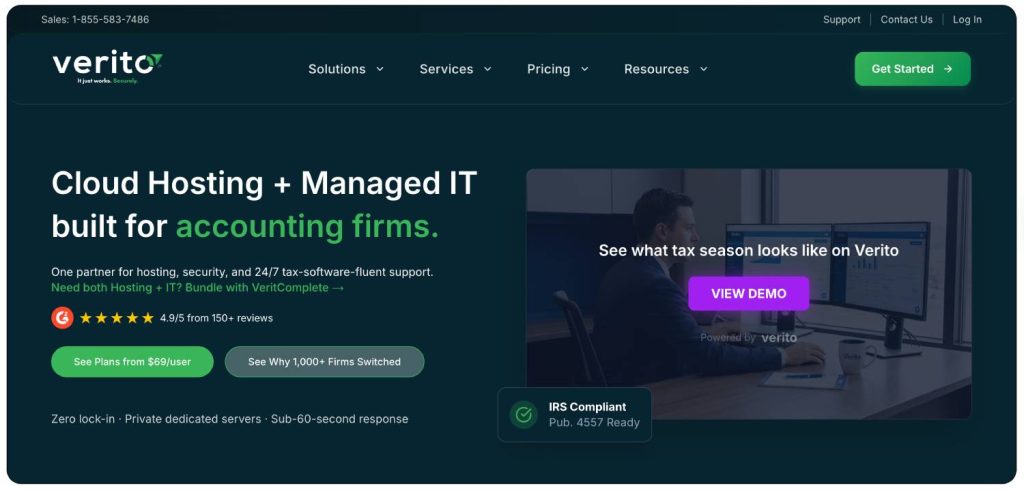
Best Overall for Firms That Cannot Afford Downtime or Compliance Gaps
Verito is a cloud hosting and managed IT provider built almost entirely around tax and accounting firms, with a secondary focus on similarly regulated law practices. Unlike generalist MSPs that serve accounting clients alongside dozens of other industries, Verito’s infrastructure, support training, and compliance framework are all oriented toward the specific demands of CPA and tax practices.
The result is an unusually coherent package: dedicated private servers tuned for multi-user QuickBooks and large tax databases, 24/7 support staffed by engineers trained on accounting and tax software, and security controls that map directly to the regulatory requirements this industry operates under. Across more than 1,000 accounting and tax firms on its platform, Verito reports sub-one-minute average response times, a 92 percent first-touch resolution rate, and a net promoter score around 95.
Security and Compliance
Verito operates on SOC 2 Type II certified infrastructure with completely isolated customer environments. No shared servers, no risk of one firm’s workload affecting another. Standard controls include MFA, endpoint detection and response, AES-256 encryption at rest and in transit, and hardened remote access.
The clearest differentiator from generalist providers is compliance documentation. Verito’s WISP support service helps firms build, update, and maintain a Written Information Security Plan that maps directly to their hosted environment and to the regulatory standards tax professionals must satisfy. Most IT providers treat WISP preparation as the client’s problem. Verito treats it as part of the service.
Accounting Stack and Hosting
Verito’s private server platform is pre-configured for QuickBooks Desktop and Enterprise, Sage 50, Lacerte, ProSeries, Drake Tax, CCH Axcess, UltraTax CS, and supporting practice management and document management tools. Servers are dedicated per firm and can scale CPU and RAM on demand during tax season without affecting other clients. Firms can run fully hosted or in a hybrid configuration.
Support
All support engineers complete an internal certification covering server administration, accounting and tax application troubleshooting, and compliance awareness before working with clients. Support is available 24/7 via phone, chat, and email.
Pricing
Month-to-month per-user pricing with no hidden fees for baseline security controls. Three bundle tiers allow firms to match cost to their actual usage profile.
Who Verito Is Best For
Accounting and tax firms with 5 to 50 users that want a single accountable partner for cloud hosting, managed IT, and compliance documentation. Particularly strong for firms preparing for a compliance audit, switching away from a generalist MSP, or recovering from tax-season downtime they cannot afford to repeat.
Website: verito.com
2. Rightworks
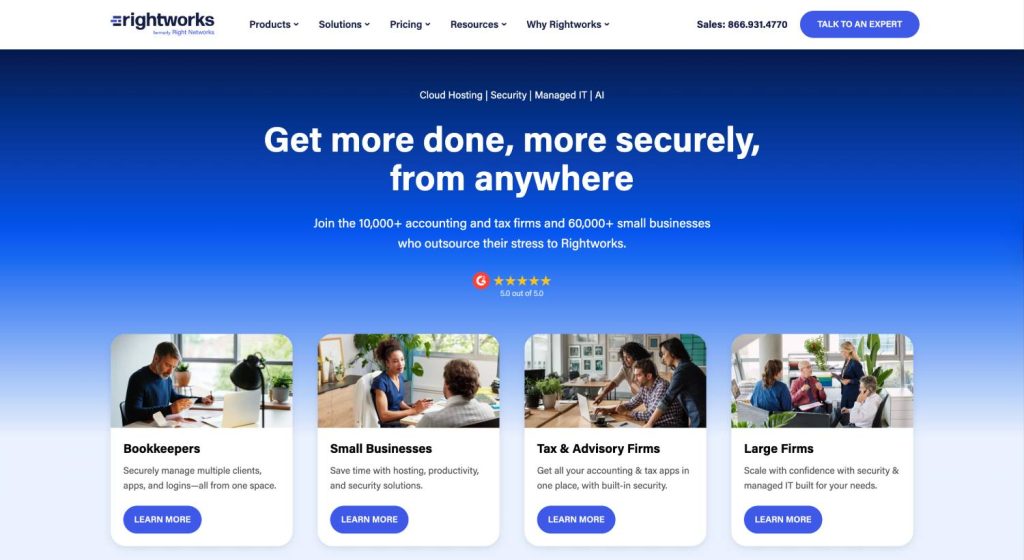
Best for QuickBooks-Centric Firms That Want a Large Cloud Ecosystem
Rightworks grew out of the Right Networks platform and has become one of the most established cloud environments in accounting technology. Its primary strength is ecosystem breadth: a large marketplace of accounting and workflow applications accessible through a single, secure cloud login.
For firms whose daily operations are built around QuickBooks Desktop or Enterprise, and who want to connect tools like SmartVault, Bill.com, Expensify, and Gusto without managing separate hosting relationships, Rightworks is a logical choice.
Security and Compliance
SOC 2-audited data centers with multi-layer encryption, MFA enforcement, real-time replication for disaster recovery, and 24/7 monitoring. The platform provides strong technical controls for firms to reference in their own compliance documentation, though hands-on WISP support is more limited than with boutique accounting specialists.
Accounting Stack
QuickBooks Desktop and Enterprise are the centerpiece, backed by an official Intuit-authorized hosting partner designation. Drake, Lacerte, Sage, and a wide range of workflow and document management integrations are also supported.
Support
24/7 U.S.-based support via phone, chat, and email. The scale of Rightworks’ client base means broad knowledge base coverage but a more standardized experience than smaller specialists deliver.
Who Rightworks Is Best For
Firms heavily invested in QuickBooks that want a proven, well-integrated cloud ecosystem with solid uptime and support. Less suitable for firms needing deep, hands-on compliance documentation support or dedicated private server environments.
Website: rightworks.com
3. Nerds Support
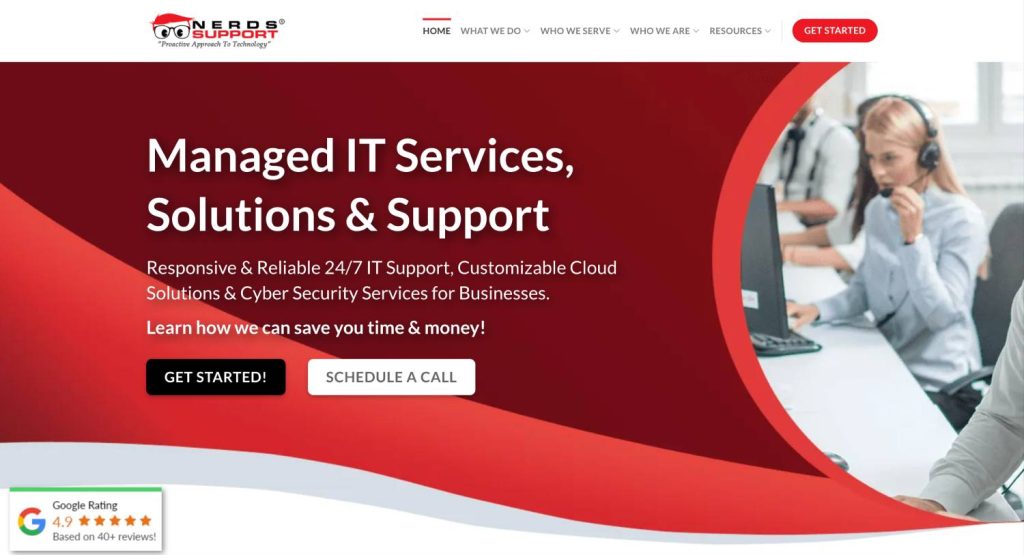
Best for Firms That Put Cybersecurity First
Nerds Support is a Miami-based managed IT provider concentrated in financial services and accounting. Its core positioning is security-first managed IT: the company leads with its 24/7 security operations center and endpoint detection and response capabilities, treating those as the foundation rather than optional layers.
For accounting firms that have experienced a security incident, are preparing for a major compliance review, or run environments with elevated exposure, such as multiple remote preparers or extensive client portal usage, Nerds Support offers security maturity that typical generalist MSPs do not reach.
Security and Compliance
SOC 2 Type II certified with a 24/7 managed SOC, AES-256 encryption, EDR on all endpoints, MFA enforcement, automated offsite backups with recovery testing, and active WISP documentation support. Engineers are well-versed in the specific regulatory requirements accounting and tax firms operate under.
Accounting Stack
QuickBooks Desktop and Enterprise, Lacerte, Drake, CCH Axcess, UltraTax, and Sage 50, configured for multi-user environments and secure remote access.
Support
Average first-response time under 15 minutes, a dedicated account manager per firm, and additional engineers allocated to accounting clients during tax season. This is the fastest stated response time among the providers on this list.
Who Nerds Support Is Best For
Mid-sized CPA firms with 5 to 50 users where cybersecurity and regulatory compliance are the primary IT priority, especially firms that have outgrown basic managed IT and need something closer to an outsourced security operations partner.
Website: nerdssupport.com
4. Solution Builders
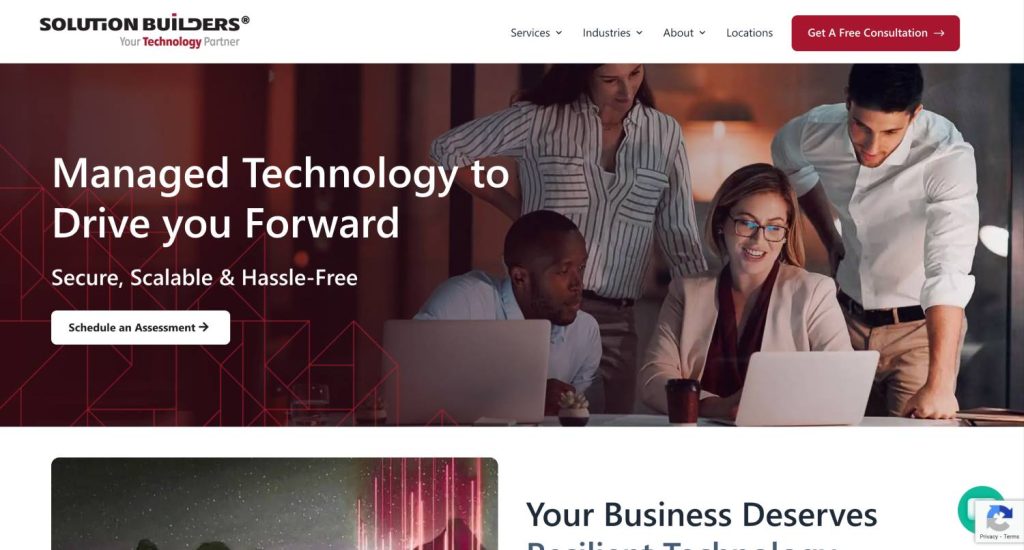
Best for Firms That Want On-Site Presence Alongside Remote Support
Founded in 1995 and headquartered in Minnesota, Solution Builders is a relationship-driven MSP with a strong base of professional services clients, including accounting and tax firms. Its primary differentiator relative to cloud-first providers is the availability of genuine on-site support, complemented by national-scale remote managed IT.
For firms that maintain significant on-premises infrastructure, operate multiple Midwest locations, or value a long-term IT relationship with someone who has physically walked their office, Solution Builders fills a gap that pure cloud providers cannot.
Security and Compliance
Zero-trust access policies, 24/7 threat monitoring, MFA and password policy management, endpoint protection, routine patching, and support for building and maintaining a WISP. Compliance deliverables are packaged into quarterly IT reports, simplifying audit preparation.
Accounting Stack
QuickBooks Desktop and Enterprise, CCH Axcess, Drake, UltraTax CS, Thomson Reuters, and Sage, plus document management and practice management integrations.
Support
24/7 U.S.-based help desk with an average first-response time under 30 minutes, plus on-site technician visits for Midwest clients. Onboarding includes a technology alignment process that maps the firm’s environment to compliance frameworks from day one.
Who Solution Builders Is Best For
Regional accounting firms, particularly those in the Midwest, that have meaningful on-premises infrastructure and want a long-term IT partner capable of both in-person and remote managed IT service.
Website: solutionbuilders.com
5. CorpTech / GoCorpTech
Best for Small Firms That Want Simple, Compliance-Aware Packages
Corporate Technologies (GoCorpTech) serves small and mid-sized businesses across 18 U.S. states with flat-rate managed IT packages. For solo practitioners and small CPA firms that want professional-grade protection without enterprise complexity, CorpTech offers clear value: structured packages with predictable pricing, no hidden fees for baseline controls, and compliance built in by default rather than bolted on.
Security and Compliance
Every plan includes MFA enforcement, full-disk encryption, centralized EDR, automated daily backups with 30-day retention, SIEM alerting, and routine patch management. All packages are aligned with FTC Safeguards requirements out of the box. Optional WISP documentation support is available as an add-on.
Accounting Stack
QuickBooks Desktop and Enterprise, Lacerte Tax, Sage 50, and Drake, with remote access setups configured for small team collaboration without local server management.
Support
24/7 remote help desk with responses typically under one hour for non-critical tickets and immediate escalation for outages. Monitoring is proactive, with patching and system health checks running in the background.
Who CorpTech Is Best For
Solo practitioners and CPA firms with 1 to 25 users that want clearly packaged IT with compliance included, at a price that scales with firm size rather than enterprise feature requirements.
Website: gocorptech.com
6. Xobee
Best for Budget-Conscious Firms That Still Need 24/7 Coverage
Xobee Networks is a California-based managed IT and cloud provider with over two decades of experience serving professional services firms, including accounting and finance. Its positioning is straightforward: dependable, around-the-clock remote IT support at a price that works for cost-conscious practices.
Xobee will not win a depth-of-accounting-expertise comparison against boutique specialists. What it offers is reliable infrastructure, 24/7/365 monitoring, and a remote-first support model that works well for distributed accounting teams operating without a large IT budget.
Security and Compliance
Zero-trust remote access, 24/7 endpoint monitoring, MFA enforcement, OS and application patching, encrypted offsite backups with daily recovery validation, firewall management, and email protection. Optional WISP assistance is available.
Accounting Stack
QuickBooks Desktop and Enterprise, Sage 50, Drake Tax, Lacerte, and UltraTax, with engineers experienced in optimizing multi-user performance for firms shifting from local servers to hybrid environments.
Support
24/7/365 help desk via phone, chat, and ticketing. Average response time under 30 minutes, with immediate escalation for critical incidents. Remote-first model suits distributed teams well.
Who Xobee Is Best For
Small to mid-sized accounting firms that need around-the-clock monitoring and help desk coverage within a tighter IT budget, and are comfortable with a provider whose client base spans multiple industries.
Website: xobee.com
7. DevsData
Best for Engineering-Heavy Projects and Staff Augmentation
DevsData is not a traditional MSP. It is a global IT consulting and engineering firm that helps accounting, finance, and SaaS companies build, modernize, or migrate technology infrastructure. The relevant question for an accounting firm is not whether they can monitor servers but whether you need project-based engineering capability that a standard help-desk MSP cannot deliver.
Relevant use cases for accounting firms include: building or integrating internal client data portals, migrating legacy on-premises servers to cloud with security oversight, developing API connections between accounting tools and analytics or CRM platforms, and implementing compliance-grade infrastructure architecture from the ground up.
Security and Compliance
ISO 27001, GDPR, and SOC 2 aligned engineering practices with secure-by-design principles, automated compliance checks, role-based access control, and data encryption standards applied across all project work.
Support Model
Project-based or retainer-based engagements with dedicated engineers, async communication, weekly sprint reviews, and milestone tracking. Not a 24/7 help desk. Firms using DevsData for engineering projects should maintain a separate MSP for day-to-day IT operations.
Who DevsData Is Best For
Larger or fast-growing accounting firms that need engineering talent for complex projects such as cloud migrations, custom application development, system integrations, or automation initiatives that a standard MSP cannot execute.
Website: devsdata.com
Detailed Comparison: All 7 Providers
| Provider | Security Cert. | App Expertise | Uptime SLA | Avg. Response | WISP Support | Contract |
|---|---|---|---|---|---|---|
| Verito | SOC 2 Type II | QuickBooks, Lacerte, Drake, UltraTax, Sage, CCH | 100% | Under 1 min | Included | Month-to-month |
| Rightworks | SOC 2 | QuickBooks (primary), Drake, Lacerte, Sage | 99.99% | 24/7, not stated | Partial | Annual typical |
| Nerds Support | SOC 2 Type II | QuickBooks, Lacerte, Drake, CCH, UltraTax | Not published | Under 15 min | Included | Quarterly or annual |
| Solution Builders | Not published | QuickBooks, CCH, UltraTax, Sage, Thomson Reuters | Not published | Under 30 min | Supported | Flexible |
| CorpTech | Not published | QuickBooks, Lacerte, Sage 50, Drake | Not published | Under 60 min | Add-on | Month-to-month |
| Xobee | Not published | QuickBooks, Sage 50, Drake, Lacerte, UltraTax | Not published | Under 30 min | Optional add-on | Monthly |
| DevsData | ISO 27001 / SOC 2 | Custom integrations, accounting tool APIs | Project scope | Project scope | Architecture-level | Custom |
Buyer’s Guide: How to Choose the Right IT Partner for Your Firm
Once you have a shortlist, the following checks let you separate credible options from vendors who will struggle under real accounting firm conditions. These questions can be worked through in a single 30-minute conversation.
Non-Negotiable Baseline Controls
Any IT partner for a CPA or tax firm should clear these five checks without hesitation:
- MFA is enforced on email, remote access, and every application touching client data. Not optional, not user-configurable.
- All firm devices run centrally managed endpoint detection and response. Backups are encrypted, tested regularly, and stored off-site.
- Cloud infrastructure has SOC 2 Type II or equivalent attestation, or a clearly documented isolation model for your firm’s environment.
- The provider can explain specifically how their controls map to your WISP and to your firm’s regulatory obligations. ‘We are SOC 2 compliant’ is not a sufficient answer.
- Response and resolution time commitments are in writing, with specific provisions covering outages during tax season.
Three Questions That Reveal Fit Quickly
1. ‘How do you help accounting firms with their data security compliance obligations?’
A strong answer describes specific controls, WISP documentation support, and how the provider maps their infrastructure to regulatory requirements. A weak answer stops at ‘we are secure’ without operational detail.
2. ‘What did your uptime and response times look like for accounting clients during last tax season?’
A strong answer includes real numbers and specific examples. Vague references to ‘high availability’ without data are a red flag.
3. ‘How quickly can you restore our accounting systems after a ransomware incident or major outage?’
You need a specific recovery time objective for your tax and accounting applications. ‘We run daily backups’ is not the same as knowing whether restoration takes one hour or twelve, and whether that has been tested.
Pricing Reference Ranges
For accounting firms combining cloud hosting, managed IT, and security from a single provider, typical all-in monthly costs per user fall into the following ranges:
| Firm Size | Typical All-In Range Per User / Month |
|---|---|
| 1 to 5 users | Approx. USD 150 to 250 |
| 6 to 25 users | Approx. USD 175 to 300 |
| 26 to 50 users | Approx. USD 200 to 350 |
These are directional benchmarks, not quotes. Proposals landing well below these ranges are typically missing endpoint protection, backup testing, or WISP support. Proposals well above them warrant a check on whether enterprise-grade features you do not operationally need are driving the cost.
Red Flags to Walk Away From
- No references from CPA or tax firms specifically. Generic ‘financial services’ case studies are not a substitute.
- Cannot explain in plain operational terms how they would contain and recover from ransomware or a compromised email account.
- Multi-year contracts with no clear, cooperative exit process.
- Endpoint protection or MFA enforcement are premium add-ons rather than standard inclusions.
- No documented record of backup restoration testing and results.
12-Point IT Compliance Checklist for Accounting and Tax Firms
Every accounting and tax firm, regardless of size, should be able to confirm each of the following. Use this when evaluating a new provider or auditing your current arrangement:
- Written Information Security Plan (WISP): current, firm-specific, and reviewed within the past 12 months.
- Multi-factor authentication enforced on all systems that access or store client data.
- Full-disk encryption on all endpoints and servers.
- SOC 2 or equivalent documentation from your cloud or hosting provider.
- Encrypted, off-site backups tested for successful restoration on a documented schedule.
- Written incident response plan covering a breach, ransomware event, or compromised account.
- Endpoint detection and response (EDR or XDR) on all firm devices.
- Real-time network monitoring for intrusions and unauthorized access.
- Email security controls: spam filtering, phishing detection, DKIM and DMARC enforcement.
- Annual security awareness training for all staff, including phishing simulations.
- Automated OS and application patch management on a defined schedule.
- Documented audit evidence: logs, reports, and records that demonstrate controls are operating as designed.
Frequently Asked Questions
1. Do small accounting firms need to comply with the FTC Safeguards Rule?
Yes. The rule applies to any firm handling client financial data regardless of size. A solo CPA is as obligated as a 50-person regional practice to maintain a WISP, enforce MFA, and conduct annual risk assessments. Firm size reduces neither the legal obligation nor a regulator’s ability to act on a complaint or breach report.
2. What is the difference between a hosting provider and a managed IT provider?
A hosting provider runs your accounting software in the cloud, typically a desktop application like QuickBooks or Drake that needs a remote server environment. A managed IT provider handles the broader picture: endpoint security, network monitoring, patch management, backup management, and compliance documentation across all devices and systems. Hosting alone does not protect your endpoints, manage email security, or help you maintain a WISP. Firms using only a hosting provider are covering just one layer of their exposure. A single provider handling both eliminates handoff gaps between your hosted environment and everything outside it.
3. Can QuickBooks Desktop be hosted securely in the cloud?
Yes, provided the environment uses dedicated or properly isolated servers rather than shared public cloud infrastructure. Shared multi-tenant hosting compromises both performance consistency and data isolation. On a dedicated private server with enforced MFA, encrypted connections, managed backups, and regular patching, hosted QuickBooks can actually improve on local server security by centralizing access, managing updates, and removing sensitive files from endpoints that can be lost or stolen.
4. How much does managed IT support typically cost for a CPA firm?
For an all-in package covering cloud hosting, 24/7 monitoring, security, compliance support, and a help desk, expect roughly USD 150 to 350 per user per month for firms with 1 to 50 users. Providers at the lower end typically exclude WISP support, advanced EDR, or backup testing. Boutique accounting-focused providers at the higher end tend to deliver faster response times, deeper application expertise, and more proactive compliance support, which often pays for itself in avoided downtime and smoother audit preparation.
5. When should a firm switch from a general MSP to an accounting-specific provider?
The clearest triggers: repeated tax-season downtime your current provider could not prevent or resolve quickly; an IT partner who cannot speak to your specific regulatory obligations; a missing or outdated WISP; a troubled cyber insurance renewal; or client security questionnaires your firm cannot answer with confidence. Any one of these is sufficient reason to evaluate alternatives. The right time to make the switch is before the next tax season, not during it.
6. What is a WISP and who should maintain it?
A Written Information Security Plan documents how a firm identifies threats to client data, implements controls to mitigate them, responds to incidents, and trains staff on data protection. It is required under IRS Publication 4557 for all tax professionals handling taxpayer data, regardless of firm size. The plan should be firm-specific and reviewed annually. Your IT provider should help draft, implement, and maintain it, mapping each policy to the actual technical controls in your environment.
Choosing the Right IT Support Partner for Your Firm
For accounting and tax firms, IT support is the foundation that keeps client data protected, filing deadlines met, and regulatory obligations satisfied. The providers that serve this industry best are not simply competent at IT. They understand accounting workflows, the applications you run, the compliance requirements you answer to, and the seasonal intensity that separates this sector from almost every other professional services category.
The seven providers ranked here each serve a distinct profile. Verito is the recommended default for most small and mid-sized CPA and tax firms that want unified cloud hosting, managed IT, and compliance support from a single partner built specifically for this industry. Rightworks is the strongest option for QuickBooks-centric firms needing mature ecosystem integrations. Nerds Support is right when cybersecurity and regulatory alignment are the primary concerns. Solution Builders serves firms that value in-person relationships and on-site capability. CorpTech provides structured, budget-friendly packages for smaller practices. Xobee delivers reliable 24/7 remote coverage at competitive cost. DevsData fills the gap when complex engineering projects exceed what a standard MSP can execute.
Use the decision shortcut at the top of this guide, the buyer’s guide questions, and the compliance checklist to shortlist one or two providers and evaluate them against your firm’s actual risk profile and growth plans. The right IT partner makes tax season less stressful, compliance less uncertain, and the answer to ‘what happens if something goes wrong’ a clear, rehearsed one.
Summary
- IT support for accounting and tax firms is a compliance decision as much as a technology one. Your provider directly affects your ability to satisfy regulatory requirements and protect client data.
- Verito ranks first overall for firms that want unified hosting, managed IT, and compliance support on an accounting-focused platform. Recommended default for most 5 to 50-user practices.
- Rightworks for QuickBooks-heavy firms. Nerds Support for cybersecurity-first posture. Solution Builders for hybrid on-site and remote. CorpTech for simple SMB packages. Xobee for budget 24/7 coverage. DevsData for complex engineering projects.
- Baseline non-negotiables for any provider: MFA everywhere, tested backups, EDR on all endpoints, audited or documented hosting isolation, and written response time SLAs.
- Typical all-in pricing runs USD 150 to 350 per user per month. Below that range, ask what is missing. Above it, verify you need what you are paying for.
- Switch providers if you see repeated downtime, unclear backup testing, a missing or stale WISP, weak MFA, or an IT partner who cannot speak to your compliance obligations in operational terms.
Editorial Disclosure
This article was produced independently and reflects the author’s evaluation of IT support providers for accounting and tax firms. Verito is among the providers reviewed. Readers should conduct their own due diligence before selecting a technology partner.